Finish What You Start
Context engineering for Claude Code. Load what you need, when you need it — 150k tokens down to 12k. Sessions that last 20+ exchanges instead of crashing at 7.
$ /plugin marketplace add qf-studio/navigator
$ /plugin install navigator
> "Start my Navigator session"
✓ 12k loaded · run /nav:stats for your efficiency report
Install plugin → · Read the docs →
MIT licensed · open source · instrumented with OpenTelemetryThe loop you’re stuck in
AI coding sessions crash at exchange 5–7. The context window fills with documentation you never use.
exchange 5  →  Claude forgets your recent changes
exchange 7  →  hallucinations start ("that function doesn't exist")
exchange 8  →  context limit reached
            →  restart · reload · re-explain · repeat
Why: you loaded 150,000 tokens of documentation “just in case.” You used 8,000. The rest is noise drowning out signal — and it’s what ends your session early.
Load what you need, when you need it
Strategic loading beats bulk loading. Three steps, no command memorization.
- Start your session — say “Start my Navigator session.” Navigator loads a ~2k index of what exists, not 150k.
- Work the feature — it lazy-loads relevant docs on demand: the task doc when you open a task, a system doc only if the work touches it.
- Finish it — sessions run 20+ exchanges and ship. When done, Navigator commits, archives the task doc, and closes the ticket on its own.
index 2k + task doc 3k + system doc 5k (only if needed)  =  ~12k loaded
                                          vs  150k loaded upfront
Enforced by a runtime, not by prose
Instructions in CLAUDE.md are suggestions — the model can ignore them, and under context pressure it does.
As of v7.0.0, Navigator’s behaviors are enforced by a hook runtime instead: one dispatcher
(hooks/nav_dispatch.py) routes op modules through a pipeline (gates → responders → injectors → recorders)
across 13 Claude Code events. Fail-open by design — a dispatcher crash never blocks your session.
- Behaviors are config, not mandates. The v6 prose mandates (WORKFLOW CHECK blocks, the session-start
ritual, the forbidden-actions list) are retired. Each behavior is now an op with an off-switch in
.agent/.nav-config.json— the root CLAUDE.md shrank from 988 to 331 lines. - New in v7 (blocking features ship disabled): zero-token instant answers for five exact commands
(
nav stats,graph health, …), a completion gate that derives six indicators from observable turn evidence (git tree, test runs, docs) before accepting “done”, knowledge-graph injection for subagents and failure diagnosis, and task-lifecycle graph sync. - Validated before shipped. All nine v6 behaviors byte-matched a recorded corpus before any new behavior landed; the conformance suite re-runs per Claude Code version (results checked in), after ~7 weeks of dogfooding on two real workloads.
How the runtime works → · Configuration → · Workflows →
See where you are
Since v8 Navigator runs inside Claude Code and draws. Type /nav and a pane opens next to the
chat; one line above the prompt says where you are.
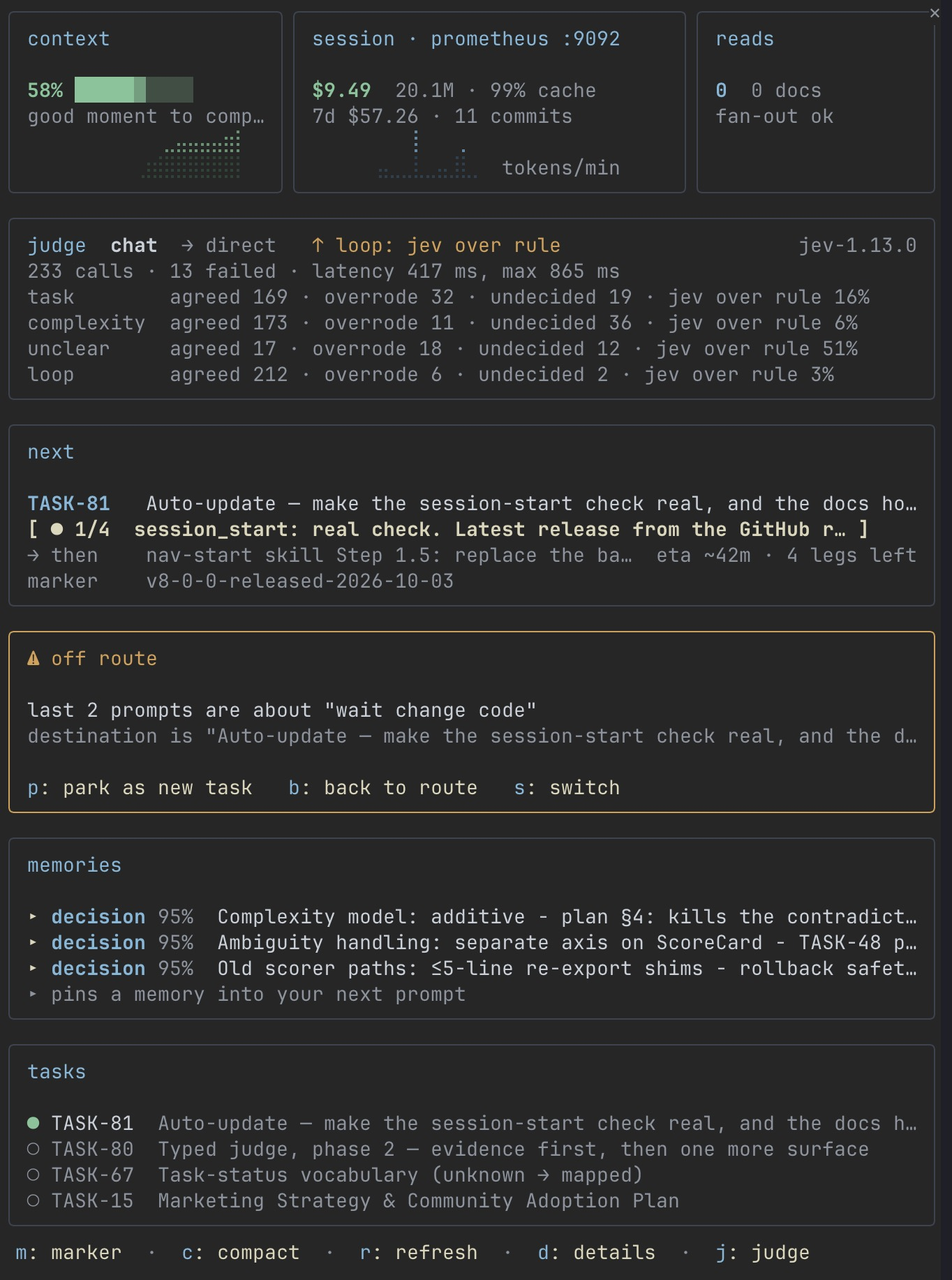
- Next — the step you’re on, as a button. Press it and it becomes your next prompt, with an ETA from your pace so far.
- Off route — two prompts in a row that have nothing to do with the task, and the card turns orange: park the detour as a task, go back, or switch.
- Judge — what the typed judge made of your last prompt and what Navigator did about it.
- Context — how full the window is, and whether it’s time to compact.
Same workflows. More capabilities.
Navigator is a superset, not an alternative. Everything you’d expect from a workflow plugin, plus context engineering and autonomy.
92% fewer tokens loaded per session (150k → 12k). The window stays open so the session finishes.
Context EngineeringClaude learns you. Preferences and frameworks remembered across sessions; collaboration drift caught and re-anchored.
Theory of Mind“Run until done.” Iterates with structured completion signals, stagnation detection, and a dual-condition exit gate.
Loop Mode“What do we know about auth?” One query across tasks, SOPs, docs, and experiential memory that persists.
Knowledge GraphNo “please commit” prompts. Navigator simplifies, commits, archives the task doc, closes the ticket — automatically.
Autonomous Completion28 active skills auto-invoke on intent. “Create a React component for profile” → component + tests + styles.
Natural-Language SkillsSee it on your own sessions
Instrumented with OpenTelemetry. The report below is example output — run /nav:stats to measure your own.
NAVIGATOR EFFICIENCY REPORT  (example)
Project documentation: 150,000 tokens
Loaded this session:    12,000 tokens
Tokens saved:          138,000 tokens (92% ↓)
Context usage:             35%
Efficiency score: 94/100- 92% fewer tokens loaded
- 20+ exchanges per session (vs 5–7 without)
- ~97.7% marker compression (a ~130k conversation → a 2–5k marker)
- Run
/nav:statsfor yours
Built for the way you actually ship
Solo developer
Start a session, implement a feature, and let Navigator commit and document it when you’re done. “Start my Navigator session” → work → autonomous finish protocol. You stop re-explaining context every restart.
When Navigator earns its keep
- Long feature work that used to die mid-session — lazy loading + context markers mean the feature ships in one sitting, and a compact never loses your place.
- Unattended runs you can trust — “Run until done” iterates with stagnation detection; the completion gate checks evidence (tree clean? tests ran?) before accepting “done.”
- Team memory that survives people — decisions, pitfalls, and SOPs are queryable and git-tracked; new developers ask “What do we know about payments?” instead of reading 150k of docs.
- Zero-token answers —
nav stats,show features,graph healthare answered deterministically by the runtime. Instant, and they can’t hallucinate.
Up and running in 30 seconds
# 1. Install
/plugin marketplace add qf-studio/navigator
/plugin install navigator
# (then restart Claude Code)

# 2. Initialize (once per project)
"Initialize Navigator in this project"

# 3. Start every session
"Start my Navigator session"
That’s it. Navigator handles the rest — lazy loading, commits, docs, and tickets.
Open source. Verified. A superset of what you already use.
| Capability | Navigator | Typical plugin |
|---|---|---|
| Structured workflows | Full skill suite | yes |
| Component & test generation | yes | yes |
| Session longevity | 20+ exchanges | 5–7 exchanges |
| Token savings | 92% (instrumented) | none |
| Theory of Mind / Knowledge Graph / Loop Mode / OTel metrics | yes | no |
| Runtime-enforced behaviors (hook dispatcher, 13 events) | yes | prose instructions |
MIT License · open source on GitHub · OpenTelemetry-instrumented
Stop restarting. Start shipping.
92% fewer tokens loaded. 20+ exchange sessions. Measured on your own work.
Install plugin → · Read the docs →
Finish what you start.